Effective solar monitoring is the difference between a high-performing portfolio and one that silently loses revenue year after year. For asset owners and operators managing utility-scale or commercial solar installations, monitoring is not just about seeing green lights on a dashboard; it is about maximizing the return on every panel, every inverter, and every dollar invested.
Here are the best practices that leading solar operators follow.
1. Monitor at the Right Granularity
Not all monitoring data is created equal. Industry best practice is 30-second to 1-minute data collection intervals for critical parameters (production, irradiance, inverter status). Coarser intervals; like 15-minute averages; can mask transient faults, partial shading events, and equipment cycling that impacts production.
At minimum, your solar monitoring platform should collect:
- Inverter AC power output (per inverter, per string where available)
- DC input voltage and current (per MPPT tracker)
- GHI and POA irradiance from on-site weather stations
- Ambient and module temperature
- Revenue meter readings
- Tracker position (for single-axis or dual-axis systems)
2. Use Irradiance Data for Performance Verification
Production numbers alone do not tell you if your system is performing well. A system producing 1 MW might be performing excellently on a cloudy day or terribly on a sunny day. The only way to know is to compare actual production against expected production based on measured irradiance.
Best practice is to maintain calibrated pyranometers or reference cells and use the data to calculate performance ratio (PR) and specific yield metrics. Your monitoring platform should automate this comparison and flag deviations.
3. Implement Tiered Alarming
Alert fatigue is real. Operators who receive hundreds of low-priority alarms per day eventually start ignoring all of them. Structure your alarm system in tiers:
- Critical; Equipment damage risk, safety issues, complete system outage. Immediate response required.
- High; Significant production loss (inverter down, tracker stuck). Same-day response.
- Medium; Moderate production impact (string underperformance, communication loss). Response within 48 hours.
- Low; Minor issues (sensor drift, cosmetic faults). Address during scheduled maintenance.
4. Track Degradation Over Time
Solar panels degrade, but the rate varies significantly. Industry expectation is 0.5-0.7% per year, but actual degradation can be higher due to manufacturing defects, environmental factors, or installation issues. Your monitoring system should track year-over-year performance trends, normalized for weather, to identify abnormal degradation early.
5. Benchmark Across Your Portfolio
If you operate multiple sites, peer-to-peer comparison is one of the most powerful tools available. Sites in similar climates with similar equipment should perform similarly. When one site underperforms its peers, that is a signal to investigate; even if the site looks fine in isolation.
6. Integrate Weather Data
On-site weather stations are essential for accurate performance analysis, but they can also provide operational value. Wind speed data helps with tracker stow decisions. Snow depth sensors trigger snow-clearing dispatch. Humidity and temperature data inform soiling models.
7. Ensure Data Integrity
Gaps in monitoring data make performance analysis unreliable. Best practice is to use edge devices with store-and-forward capability; local data loggers that cache data during network outages and backfill when connectivity is restored. This ensures zero data loss even in remote locations with unreliable internet.
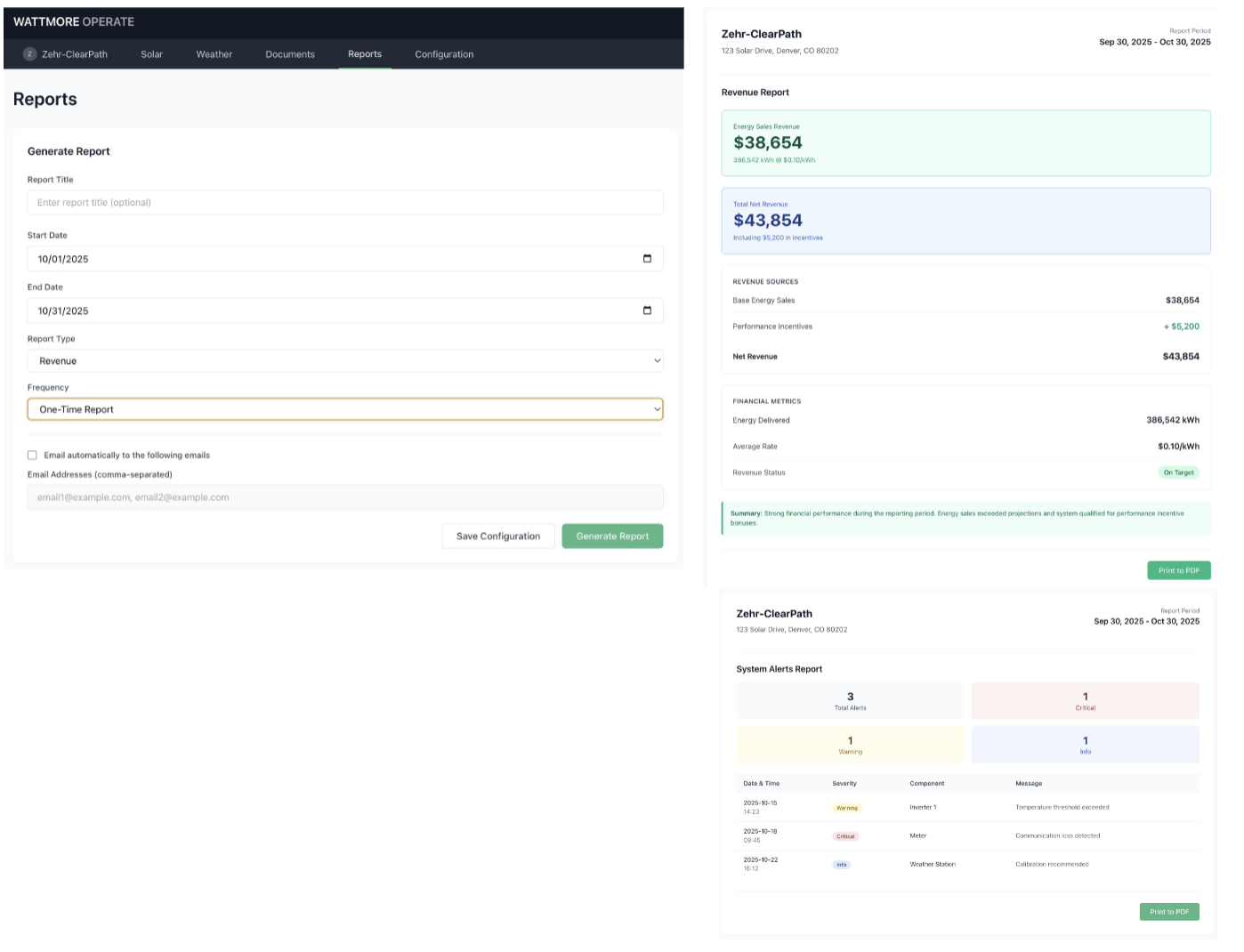
8. Automate Reporting
Investors, offtakers, and management all need regular reports. Automating report generation; monthly performance reports, quarterly investor updates, annual degradation analyses; saves time and ensures consistency.
WATTMORE's Intellect EnFORM platform implements all of these best practices in a single, vendor-agnostic solar monitoring solution. Contact us to learn how EnFORM can improve your solar operations.