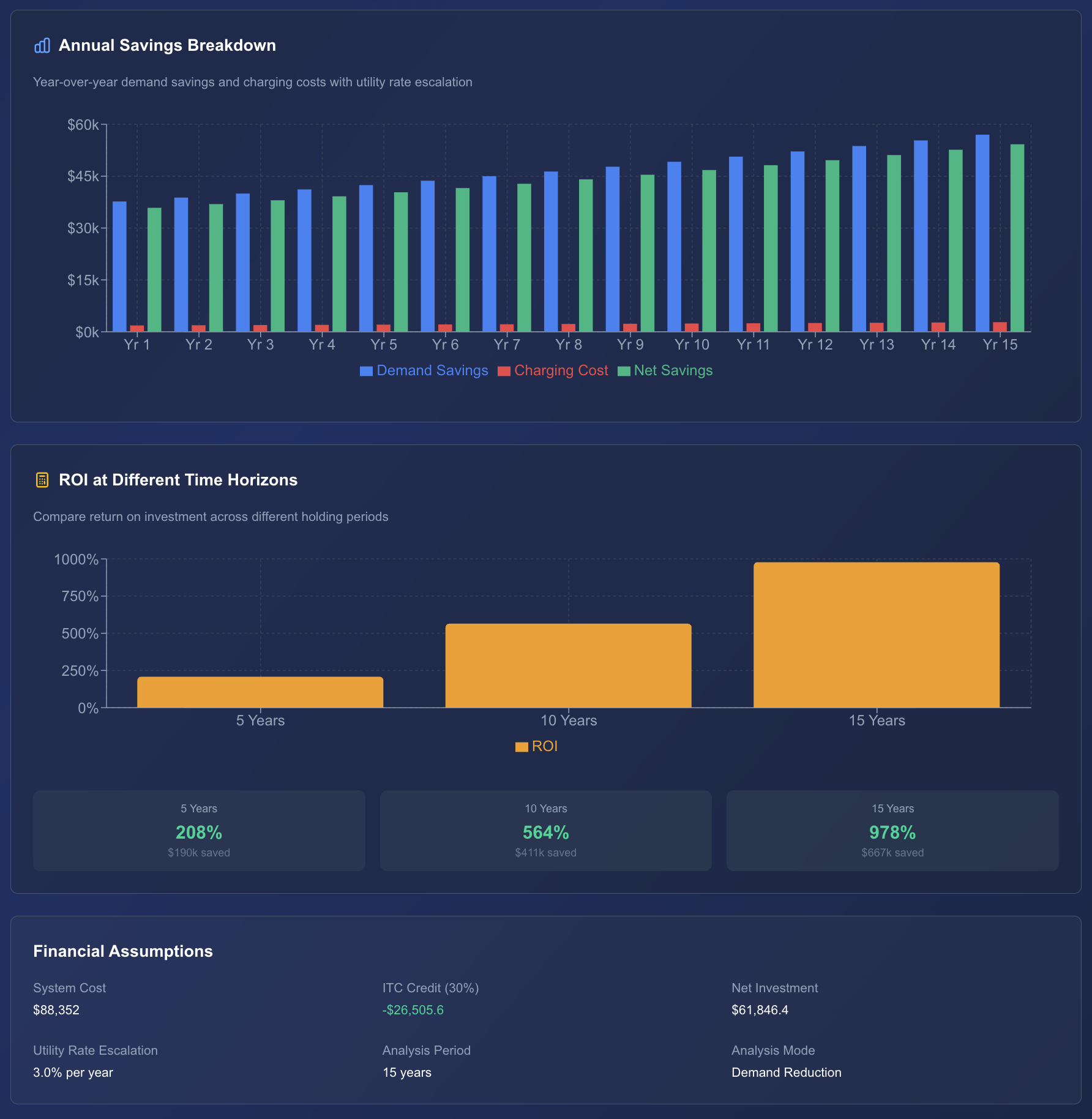
Energy storage financial modeling is the process of projecting the economic returns of a battery storage investment over its operational lifetime. For project developers seeking financing, asset owners evaluating expansions, or C&I customers considering behind-the-meter storage, a credible financial model is essential for making informed investment decisions.
This article explains the key financial metrics, common pitfalls, and best practices for energy storage financial modeling.
Key Financial Metrics
Return on Investment (ROI)
ROI measures the total return relative to the total investment. For energy storage, this means total lifetime revenue (savings + market income) divided by total project cost (equipment + installation + ongoing O&M). While ROI is the most intuitive metric, it does not account for the time value of money, which is why more sophisticated metrics are also needed.
Net Present Value (NPV)
NPV discounts all future cash flows back to present value using a specified discount rate, then subtracts the initial investment. A positive NPV means the project creates value above the required rate of return. NPV is generally considered the most reliable metric for investment decisions because it accounts for the time value of money and the total dollar value created.
Internal Rate of Return (IRR)
IRR is the discount rate at which NPV equals zero; essentially, the annualized return of the investment. For energy storage projects, IRRs typically range from 8-25% depending on the market, tariff structure, and revenue mix. Investors use IRR to compare storage projects against other investment opportunities.
Payback Period
The payback period is the time required to recoup the initial investment. Simple payback ignores the time value of money; discounted payback accounts for it. For C&I battery storage, payback periods of 4-7 years are common, with the project continuing to generate returns for an additional 8-13 years.
Revenue Inputs
A complete energy storage financial model must account for all applicable revenue streams:
- Demand charge savings; Reduction in monthly demand charges through peak shaving
- TOU arbitrage; Difference between off-peak charging costs and peak discharge revenue
- Grid services revenue; Payments for frequency regulation, spinning reserve, capacity
- Solar self-consumption; Avoided energy costs from storing and using own solar production
- Incentive payments; ITC, state incentives, utility rebates
- Resilience value; Quantified value of backup power capability
Cost Inputs
- Equipment costs; Battery modules, inverters, transformers, BOS
- Installation and commissioning; Construction, electrical, permitting
- EMS software; Storage EMS licensing and support fees
- Ongoing O&M; Maintenance, monitoring, insurance
- Augmentation; Battery capacity additions to offset degradation (for long-duration contracts)
- Decommissioning; End-of-life disposal or recycling costs
Common Financial Modeling Pitfalls
- Ignoring degradation; Battery capacity declines 2-3% per year. Models that assume constant capacity overstate returns.
- Simplified dispatch assumptions; Many models assume perfect foresight or simple rule-based dispatch. Real-world revenue is lower than theoretical maximum.
- Static tariff assumptions; Utility rates change. Models should include rate escalation scenarios.
- Overlooking round-trip efficiency; Lithium-ion batteries lose 10-15% of energy in each charge/discharge cycle. This must be modeled.
- Not modeling revenue stacking properly; Simply adding individual value stream estimates overstates returns because they compete for the same battery capacity.
Best Practice: Use Real Dispatch Algorithms
The most credible financial models use real dispatch optimization; the same algorithms that will control the battery in operation. This eliminates the gap between projected and actual performance that plagues simplified models.
WATTMORE's Intellect PLAN provides energy storage financial modeling powered by the same optimization engine as Intellect Operate. Projections typically match actual performance within 5%. Contact us for a project analysis.