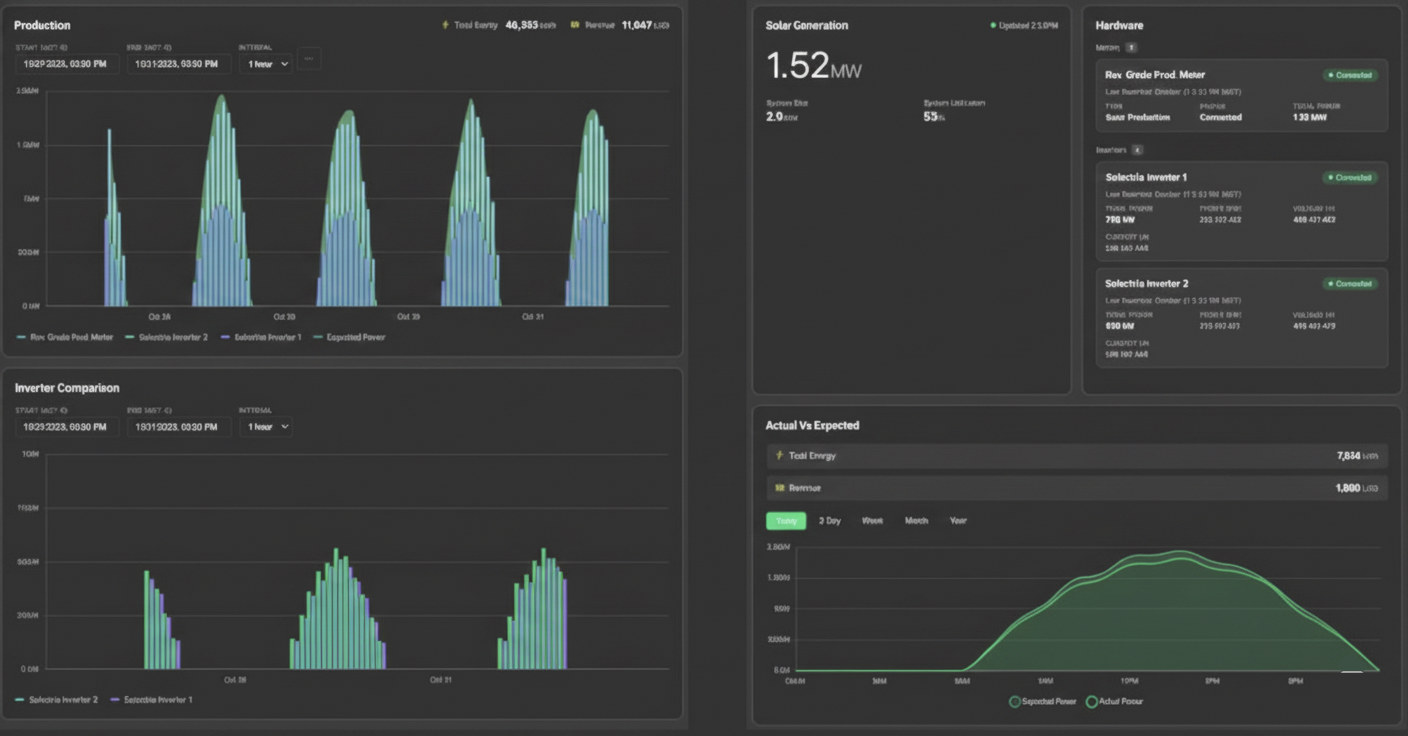
A Solar Energy Management System (Solar EMS) is a software platform that monitors, analyzes, and optimizes solar power generation. Unlike basic inverter monitoring that only shows whether panels are producing power, a solar EMS provides comprehensive visibility into every aspect of system performance; from individual string-level data to portfolio-wide analytics.
What Does a Solar EMS Do?
A solar energy management system serves as the central nervous system for solar operations. Its core functions include:
Real-Time Monitoring and Control
A solar EMS provides 30-second granularity dashboards showing production, irradiance, temperature, and equipment status across every component of your system. Operators can see real-time performance, identify underperforming assets, and take corrective action immediately.
Performance Verification
How do you know if your solar system is performing as expected? A solar EMS compares actual production against modeled expectations using GHI/POA irradiance data, peer-to-peer benchmarking, and financial model reconciliation. This identifies degradation, soiling, shading, and equipment issues before they significantly impact revenue.
Load Management
For behind-the-meter installations, a solar EMS manages the interaction between solar production, site load, battery storage, and grid import/export. It optimizes self-consumption, manages export limits, and coordinates with utility tariff structures to minimize costs.
Battery Optimization
In solar-plus-storage systems, the solar EMS coordinates solar production with battery charging and discharging. It forecasts solar output, predicts load patterns, and optimizes the combined system to maximize value; whether that means self-consumption, peak shaving, or market participation.
Grid Compliance
Utility interconnection agreements often include requirements for power factor correction, ramp rate control, voltage regulation, and curtailment capabilities. A solar EMS manages all of these automatically, ensuring continuous compliance.
Benefits of Using a Solar Energy Management System
Increased Savings
A solar EMS maximizes the financial return on your solar investment by identifying and correcting performance issues quickly, optimizing self-consumption, and ensuring you capture all available value from your system.
Enhanced Reliability
Automated monitoring with intelligent alarming means equipment issues are detected and reported immediately; not discovered weeks later during a manual inspection. Predictive analytics can identify potential failures before they cause downtime.
Data Security
Enterprise-grade solar EMS platforms provide secure data storage, encrypted communications, role-based access control, and compliance with industry security standards. Your operational data is protected from unauthorized access.
Portfolio Scalability
Whether you have one site or hundreds, a solar EMS provides a single platform for managing your entire fleet. Standardized monitoring, centralized alarming, and comparative analytics make it practical to manage large portfolios without proportionally scaling staff.
Solar EMS vs. Inverter Monitoring
Most inverter manufacturers provide basic monitoring portals, but these have significant limitations:
- They only show data from their own equipment; you cannot see a unified view across different inverter brands
- Data granularity is often limited (5-15 minute intervals vs. 30-second from a dedicated solar EMS)
- Analytics capabilities are basic; no performance modeling, no peer comparison, no financial reconciliation
- No integration with weather stations, meters, trackers, or storage systems
A dedicated solar energy management system like WATTMORE's Intellect EnFORM integrates all equipment types, all protocols, and all manufacturers into a single platform with advanced analytics and enterprise-grade reliability.
Contact WATTMORE to see how Intellect EnFORM can improve visibility and performance across your solar portfolio.