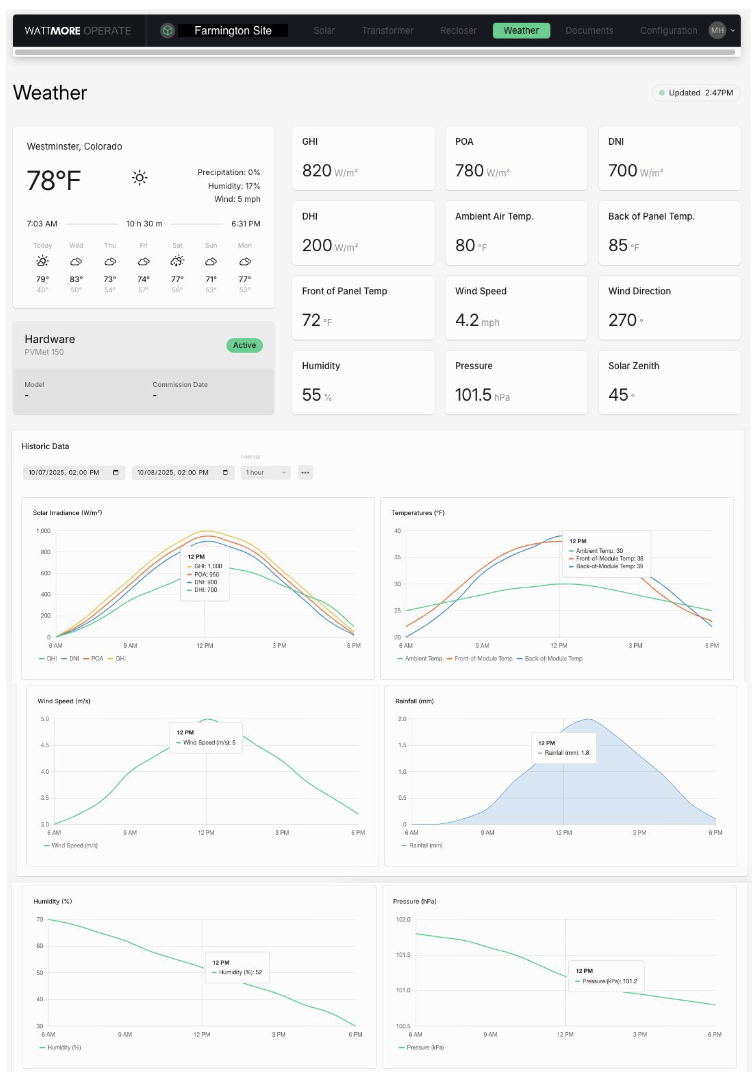
Weather data acquisition is a foundational component of professional solar and energy storage operations. Accurate, real-time weather data enables everything from performance verification to predictive dispatch optimization. Yet many project owners underinvest in weather instrumentation and data systems, leaving significant value uncaptured.
What Is Weather Data Acquisition?
Weather data acquisition refers to the collection, transmission, and processing of meteorological measurements at or near a solar or storage installation. A weather data acquisition system (DAS) typically includes physical sensors (pyranometers, anemometers, thermometers, barometers), a data logger, and communication infrastructure to transmit readings to a central monitoring platform.
Key Weather Parameters for Solar Operations
Irradiance (GHI and POA)
Global Horizontal Irradiance (GHI) and Plane of Array (POA) irradiance are the most critical measurements for solar performance analysis. POA irradiance; measured in the same plane as the solar panels; is the primary input for calculating expected production and performance ratio. Without accurate irradiance data, you cannot determine whether your system is underperforming.
Ambient and Module Temperature
Solar panel efficiency decreases as temperature increases; typically 0.3-0.5% per degree Celsius above 25C. Accurate temperature measurements are essential for performance modeling, degradation analysis, and predicting seasonal production variations.
Wind Speed and Direction
Wind data serves multiple purposes. For tracker-equipped systems, wind speed triggers stow commands to protect panels during high-wind events. Wind also affects panel cooling; higher winds reduce module temperature and improve performance. For energy storage, wind data can inform load forecasting models.
Humidity and Precipitation
Humidity affects soiling rates and influences panel degradation in certain climates. Precipitation data helps calibrate soiling models; heavy rain cleans panels while light mist can actually increase soiling. This data informs cleaning schedules and maintenance planning.
Barometric Pressure
While less directly impactful, barometric pressure data improves weather forecasting accuracy when combined with other measurements. For storage systems that use price or load forecasting, better weather predictions translate to better dispatch decisions.
Weather Data and Energy Storage
Weather data is not just for solar. For battery energy storage systems, weather information improves:
- Load forecasting; Temperature drives HVAC load, which is often the largest variable in commercial demand profiles
- Solar production forecasting; For solar-plus-storage systems, accurate solar forecasts enable better battery dispatch
- Grid condition prediction; Extreme weather often correlates with grid stress, creating opportunities for storage to provide high-value services
- Battery thermal management; Ambient temperature data helps optimize HVAC systems in battery containers
Solar DAS Best Practices
- Use research-grade sensors; Thermopile pyranometers (ISO 9060 Class A or B) provide the most accurate irradiance measurements. Reference cells are acceptable for monitoring but less accurate for performance testing.
- Calibrate regularly; Pyranometers should be recalibrated every 2 years. Sensor drift is a common source of performance analysis errors.
- Install redundancy; At least two irradiance sensors per site allows cross-validation and continued monitoring if one sensor fails.
- Ensure high-frequency sampling;1-second raw sampling with 1-minute averages provides the granularity needed for transient analysis.
- Use store-and-forward logging; Edge data loggers should cache data locally to prevent gaps during network outages.
WATTMORE's Intellect EnFORM integrates seamlessly with all major weather station manufacturers and provides automated data validation, gap filling, and performance analytics. Contact us to learn more about our data acquisition capabilities.