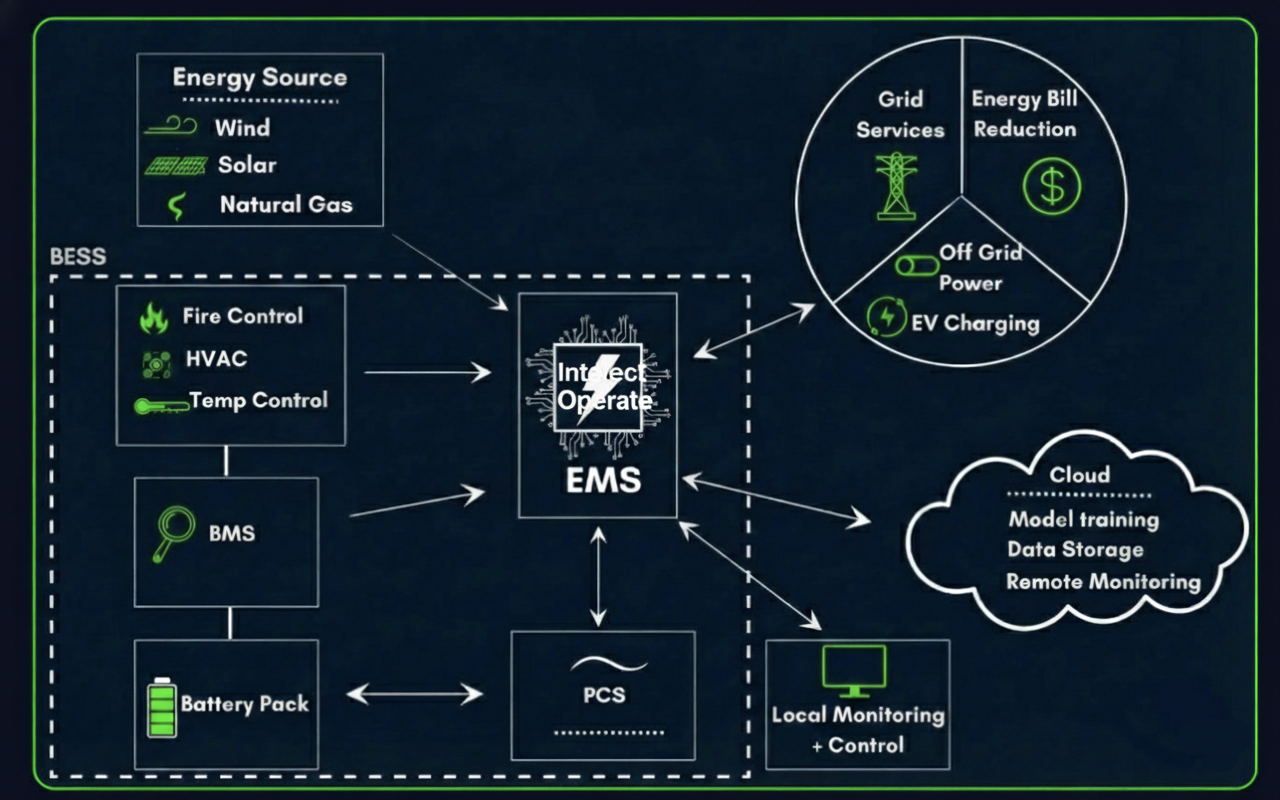
A battery energy management system (Battery EMS) is the software platform that controls and optimizes the operation of battery energy storage systems. Whether you call it a storage EMS, energy storage EMS, or BESS EMS, this technology is the intelligence layer that determines when batteries charge, when they discharge, and how they participate in energy markets.
This guide covers everything you need to know about battery energy management systems; what they do, how they work, and why they matter for energy storage projects.
How a Battery Energy Management System Works
A battery energy management system sits between the physical battery hardware and the economic objectives of the project owner. It continuously processes data from multiple sources:
- Battery management system (BMS); State of charge, cell voltages, temperatures, state of health
- Inverters and power conversion systems; Active power, reactive power, grid frequency
- Meters; Site load, solar production, grid import/export
- External signals; Wholesale energy prices, ancillary service signals, weather forecasts, utility tariff schedules
Using this data, the battery EMS makes real-time dispatch decisions; typically every few seconds; to maximize the economic value of the storage asset while maintaining safety constraints and warranty compliance.
Core Functions of a Battery Energy Management System
Real-Time Dispatch
The primary function of any battery EMS is controlling when and how much the battery charges or discharges. This involves solving complex optimization problems that balance multiple objectives: maximizing revenue, minimizing degradation, maintaining grid compliance, and protecting battery health.
Revenue Optimization
A battery energy management system maximizes project economics by stacking multiple value streams. These include demand charge reduction, TOU arbitrage, frequency regulation, spinning reserve, capacity payments, and renewable energy self-consumption optimization.
Grid Services
Modern energy storage participates in grid services programs that require fast, accurate response to operator signals. The battery EMS handles automatic generation control (AGC), frequency response, voltage regulation, and demand response; all while maintaining safe operating limits.
Monitoring and Alerting
Beyond active control, the battery EMS provides comprehensive monitoring of all system components. It tracks performance metrics, detects anomalies, generates alarms, and provides the data needed for reporting to investors, utilities, and grid operators.
Warranty and Health Management
Battery warranties typically specify operating limits for depth of discharge, charge/discharge rates, temperature ranges, and annual throughput. A well-designed battery energy management system enforces these limits automatically, protecting the asset owner's investment.
Battery EMS vs. SCADA vs. BMS
These three systems serve different purposes and should not be confused:
- BMS (Battery Management System); Hardware-level protection. Monitors individual cells and modules, prevents thermal runaway, manages cell balancing. Every battery has a BMS regardless of the EMS.
- SCADA (Supervisory Control and Data Acquisition); Data collection and visualization. Monitors system status and provides operator interfaces, but does not optimize dispatch.
- Battery EMS; Economic optimization and automated control. Makes intelligent dispatch decisions to maximize revenue and value. This is the layer that turns a battery from a passive asset into an active revenue generator.
Why a Battery Energy Management System Matters
The difference between a well-optimized battery EMS and a basic control system can be 15-30% of annual revenue. Over a 15-20 year project life, that gap amounts to millions of dollars in lost value. For project developers, asset owners, and investors, the battery energy management system is not just a software layer; it is a core driver of project economics.
WATTMORE's Intellect Operate is a battery energy management system designed for maximum performance. Learn more about Intellect Operate or request a demo.