Battery sizing is one of the most consequential decisions in an energy storage project. An undersized battery leaves revenue on the table. An oversized battery wastes capital. Getting it right requires rigorous analysis of your load profile, tariff structure, revenue goals, and site constraints.
This guide walks through the battery sizing process step by step.
Step 1: Gather Your Load Data
The foundation of any battery sizing analysis is historical load data. You need at minimum 12 months of 15-minute interval data from your utility meter. This data reveals:
- Your peak demand (the kW value that drives demand charges)
- Your load shape (when peaks occur, how long they last, how predictable they are)
- Seasonal patterns (summer cooling peaks, winter heating peaks, production schedules)
- Base load vs. variable load (how much of your consumption is constant)
If 15-minute data is unavailable, monthly billing data can provide a rough starting point, but the results will be far less accurate.
Step 2: Understand Your Tariff
Your utility tariff determines the economic value of every kWh the battery stores and delivers. Key tariff components to analyze:
- Demand charges;$/kW for peak demand, often the largest savings opportunity
- Time-of-use rates; Different $/kWh prices for different time periods
- Coincident peak charges; Demand charges based on your usage during system-wide peaks
- Standby charges; Fees that apply when you reduce grid demand below a threshold
- Ratchet clauses; Provisions that set your demand charge based on the highest peak over multiple months
Step 3: Define Your Use Case
Different use cases require different battery configurations:
- Peak shaving only; Requires high power (kW) relative to energy (kWh). Typical duration: 1-2 hours.
- TOU arbitrage; Requires more energy capacity for longer discharge periods. Typical duration: 2-4 hours.
- Solar self-consumption; Size depends on the mismatch between solar production and load. Typically 2-4 hour duration.
- Backup power; Size based on critical load and required backup duration. Often 4+ hours.
- Grid services; Requirements vary by program. Frequency regulation may need high power with limited energy; capacity programs may need 4-hour duration.
Step 4: Model the Economics
With load data, tariff, and use case defined, the next step is running optimization models to find the sweet spot where battery economics are maximized. A battery sizing tool should evaluate:
- Multiple battery sizes (power and energy combinations)
- Revenue from all applicable value streams simultaneously
- Battery degradation over the project lifetime
- Round-trip efficiency losses
- Parasitic loads (HVAC, BMS, communication equipment)
- Tariff escalation assumptions
The output should include ROI, NPV, IRR, payback period, and annual savings projections for each configuration.
Step 5: Account for Degradation
Lithium-ion batteries lose capacity over time; typically 2-3% per year depending on usage patterns. Your sizing analysis must account for this: a battery sized perfectly for Year 1 will be undersized by Year 10. Best practice is to size for end-of-life performance requirements, which means oversizing slightly for Day 1.
Step 6: Validate with Real Dispatch Algorithms
Many battery sizing tools use simplified assumptions about how the battery will operate. The most accurate approach is to use the same optimization algorithms that will control the battery in the field. This ensures your projections match real-world performance.
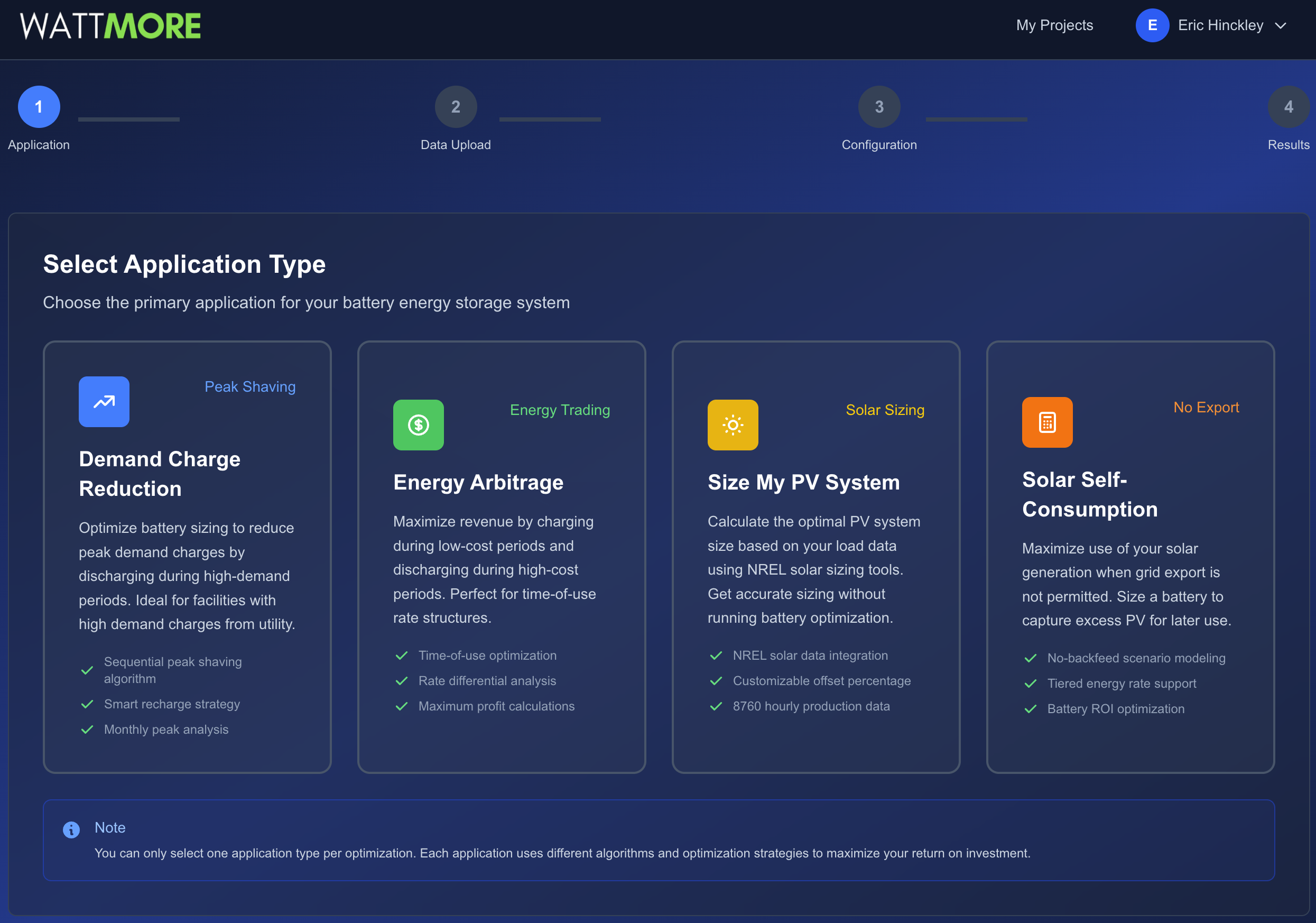
WATTMORE's Intellect PLAN uses the exact same dispatch algorithms as Intellect Operate, our production storage EMS. Your sizing projections reflect actual dispatch strategies; not simplified models. Contact us for a complimentary battery sizing analysis.